
In my recent brief to the Philippines Ministry of Health on 10 June 2026, I mapped out the stake of evolving global AI surveillance landscape and Taiwan’s blueprint for an AI-first roadmap to health surveillance. For this post, I have highlighted six pivotal global advancements that are currently reshaping the field. Download my public-version deck here: AI-enabled Intelligent Transformation of International Outbreak Monitoring.

By mid-2026, agentic and generative AI are no longer just buzzwords—they are actively deployed across global epidemic intelligence systems. While human in the loop (HITL) remains the indispensable anchor of these networks, the technology driving them has evolved rapidly. Here is a look at six pivotal developments reshaping the global event-based surveillance and depidemic intelligence landscape:
1. The Global Bio-Surveillance Landscape
Today’s ecosystem spans official portals, automated scrapers, and AI-native platforms. Working at Taiwan CDC, I frequently reference fourteen major systems below operating across distinct access tiers:
| System | Access / Type | Core Focus & Technology |
|---|---|---|
| WHO EIOS 2.0 | Restricted / Official | Secure IHR portal for sensitive, official country alerts |
| WHO DON | Public / Official | Verified, authoritative global outbreak notices |
| WHO Regional | Public / Official | Routine regional bulletins |
| ECDC / EuroSurveillance | Public / Regional | Peer-reviewed science paired with EU outbreak tracking |
| WOAH | Public / Official | Animal health and zoonotic spillover |
| GPHIN | Restricted / Government | Canadian EBS pioneer; automated multilingual email alerts |
| HealthMap | Public / Automated | 2006 pioneer; automated web-scraping and live mapping |
| ProMED | Paid / Expert | Crowdsourced alerts verified by experts + AI summaries |
| BlueDot | Paid / Enterprise | Risk alerts at 3 severity levels with flight data integration |
| CIDRAP | Public / Academic | High-quality news and policy analysis |
| EPIWATCH | Paid / Enterprise | 50+ language AI-OSINT for early outbreak detection |
| BEACON | Public / Academic | Founded 2025. Custom AI agents & domain-adapted LLMs. Highly recommended. |
| Outbreak News Today | Public / Media | Active independent news hub |
| Avian Flu Diary | Public / Expert Blog | Rapid expert analysis of influenza and avian threat data |
2. BEACON
Launched in April 2025 by Boston University and HealthMap, BEACON (Biothreats Emergence, Analysis and Communications Network) is the first event-based surveillance system built natively on generative AI.
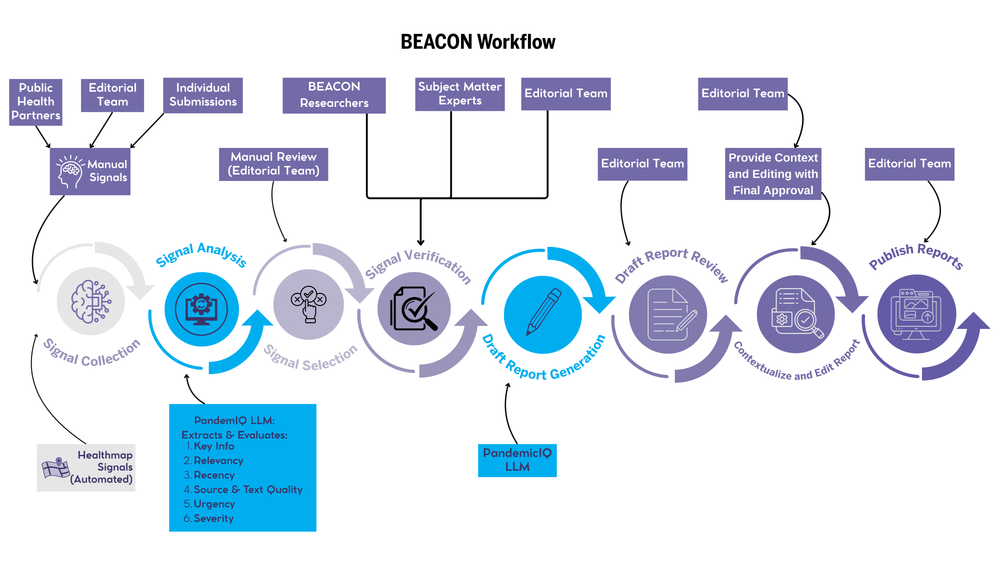
At its core is PandemIQ Llama — a domain-adapted LLM trained on 5.7 billion tokens across 31 languages and 16 priority pathogens. The architecture deploys multiple AI agents, each with a custom-engineered prompt embedding expert decision logic: extracting key facts, assessing source credibility, evaluating severity and urgency, then drafting structured outbreak reports. Editorial staff review and expand each draft before publication.
3. An Epidemiological Knowledge Graph for WHO DON
Beyond real-time detection, 2025 saw a structural upgrade to one of the field’s foundational data sources. Consoli et al. constructed a machine-readable knowledge graph from the entire WHO Disease Outbreak News (DON) corpus, linking outbreak entities — diseases, locations, dates, case counts — to standardised biomedical ontologies (NCBO BioPortal) and geolocation databases (GeoNames).
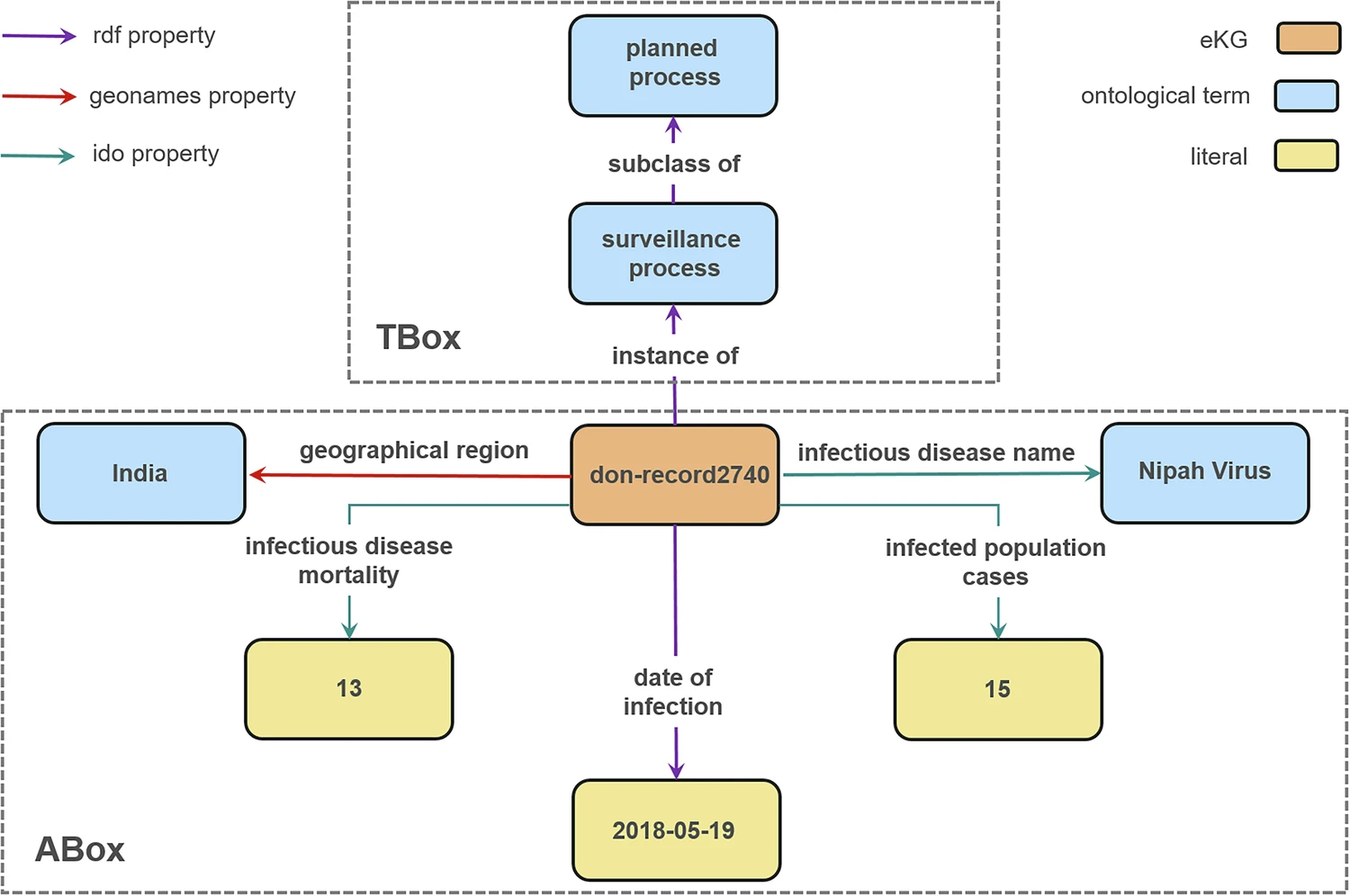
This enables large-scale structured querying of global outbreak patterns previously buried in unstructured text — a foundational infrastructure upgrade for any surveillance pipeline relying on WHO DON data.
4. ARIES — hierarchical multi-agent architecture
The ARIES framework (arXiv 2026) formalises a hierarchical multi-agent architecture that replicates — and can exceed — the investigative workflow of a human epidemiologist in speed and cross-source verification.
A Manager Agent coordinates three specialised sub-agents, each assigned a domain persona:
- Senior Medical Scientist — clinical interpretation
- CDC Data Analyst — quantitative risk scoring
- WHO Intelligence Officer — geopolitical and policy context
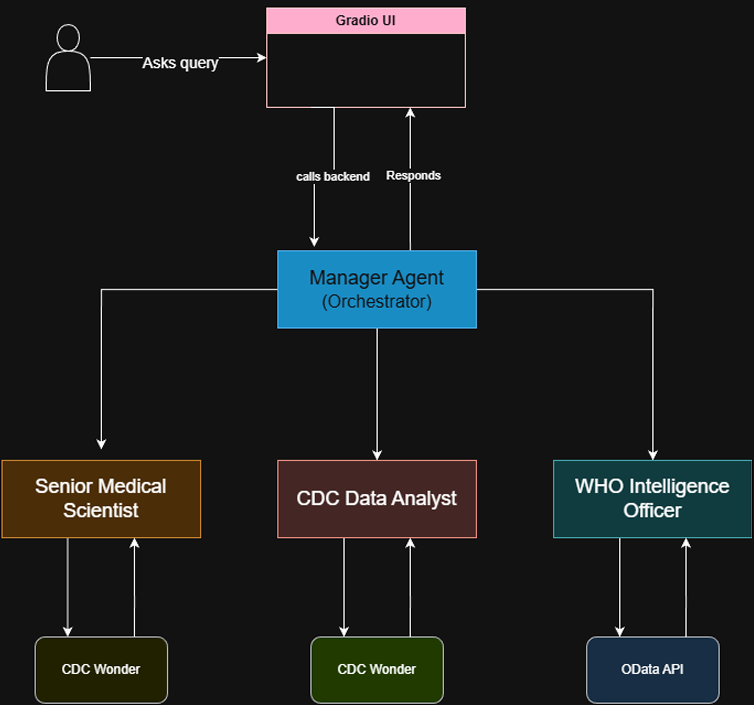
Core components (Flows, Crews, Agents, Process, Tasks) are configurable across memory, LLMs, and reasoning chains. Inspired by zero-shot classification achieving 90.2% precision on COVID-19 and Mpox datasets, ARIES is designed to reduce hallucination by retrieving only current, task-relevant information. The roadmap includes MCP integration and automated weekly epidemiological records.
5. The Pandemic Preparedness Engine
Announced at the World Economic Forum Annual Meeting in January 2026, the Pandemic Preparedness Engine (PPX) is an end-to-end R&D platform integrating genomic surveillance, epidemiological modelling, viral evolution tracking, and antigen design — all coordinated by agentic AI.
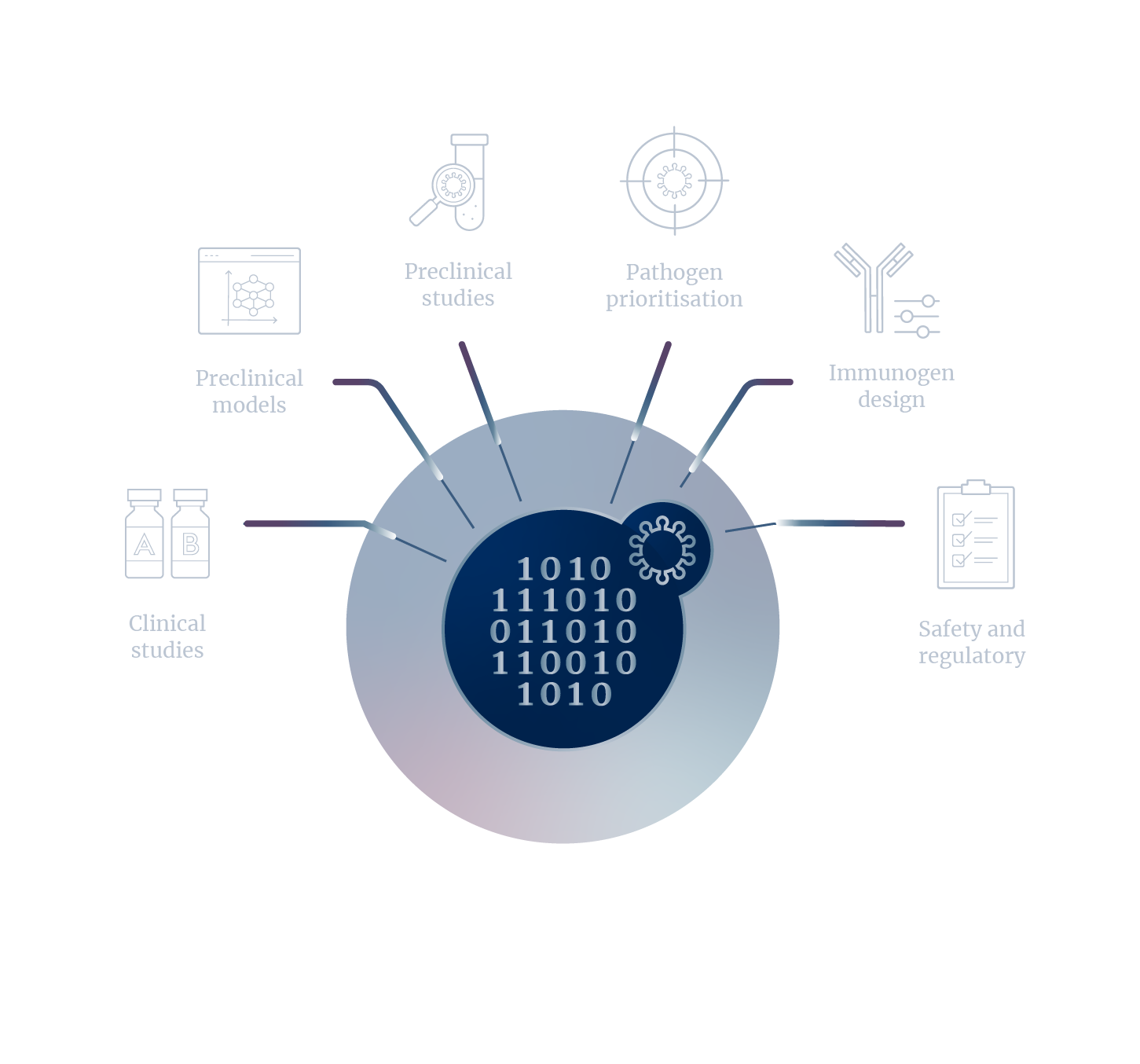
PPX was framed explicitly as a global public good rather than a proprietary tool.
6. An Indicator Framework for Event-Based Surveillance
How do we know whether a surveillance system is actually performing? A Lancet Global Health paper proposes a structured monitoring and evaluation framework designed specifically for event-based surveillance (EBS).
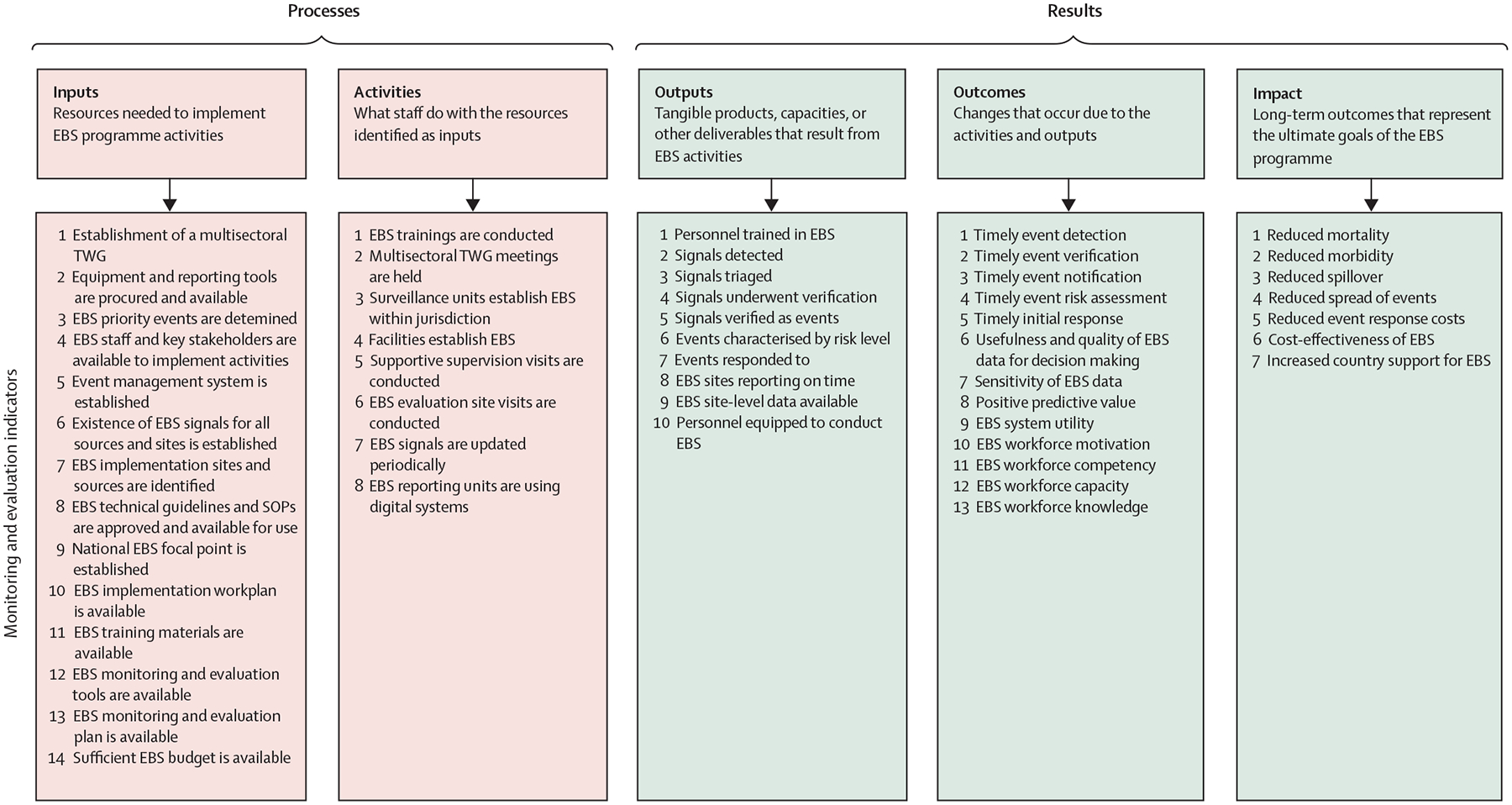
The framework distinguishes input, process, and output indicators — bridging system architecture and measurable public health outcomes. For agencies building or scaling EBS platforms, this provides a testable standard against which AI-powered systems such as BEACON, EIOS, and ARIES can be held accountable.
Views expressed here are my own and do not represent the views of my employer, Taiwan Centers for Disease Control.